Meme Coin Trading: Anatomy of a $450,000 Month
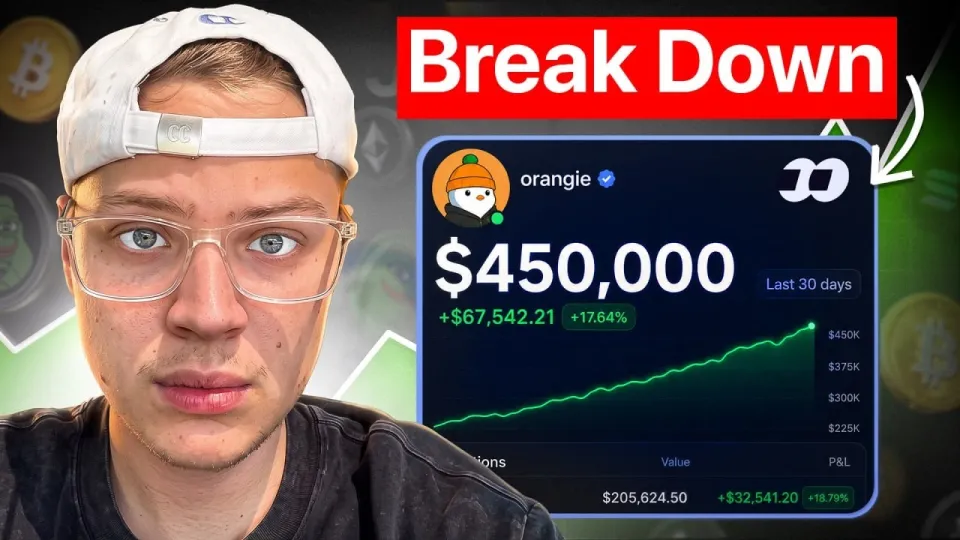
Video: How I Made $450,000 Trading Memecoins in 30 Days
Need articles like this for your video? They help promote it on YouTube and Google — order them in the Telegram bot @sat_sit_bot. The bot writes and publishes the articles itself (with your YouTube video embedded) on popular topical websites (no ads). Your first 50 articles are free.
· based on the channel Orangie Web3
Key takeaways
- Orangie Web3 reports turning roughly $450,000 in profit from meme coin trading across a single 30-day window, documented in a video published on 3 September 2026.
- The strategy is built on Solana meme coins: early entries on fresh launches, small initial size, and scaling only after the position proves itself.
- Access to curated calls and a trading community is sold through a paid group on Whop, with the FOMO platform used as the execution venue.
- Most meme coin launches fail; the model assumes a high loss rate on small bets and relies on a handful of outsized winners.
- Viewer reports in the comments range from tripling a small balance on one coin to losing around 90% of a $100 starting stake.
Meme coin trading is the practice of buying newly launched tokens that are driven by internet culture rather than cash flow, and the $450,000 figure reported by Orangie Web3 for a single 30-day stretch shows both the upside and the mechanics behind it: small early entries on Solana launches, fast exits, and a tolerance for frequent total losses. The full breakdown sits in the video How I Made $450,000 Trading Memecoins in 30 Days, and the paid Kaizen group linked there is where the calls and tooling are distributed.
What a meme coin actually is and why it moves so fast
A meme coin is a token with no product, revenue or roadmap attached; its price is a pure function of attention, liquidity and the order book. Dogecoin established the template, but the current cycle runs on Solana, where launchpads let anyone mint a token in minutes and a bonding curve pushes it onto a decentralised exchange once a market-cap threshold is crossed.
That structure produces three things traders exploit:
- Near-zero launch cost. Thousands of tokens appear daily, so supply of new tickers is effectively infinite.
- Thin early liquidity. A few thousand dollars of buying can move price double digits, which is why early entries look spectacular on screenshots.
- Fast narrative rotation. A token can go from unknown to a nine-figure valuation and back to near-zero inside a week, driven by social feeds rather than fundamentals.
The practical consequence: meme coin trading is a liquidity and attention game, not an investing discipline. Anyone treating a token as a long-term hold is misreading the instrument.
The playbook behind the $450,000 month
Orangie's approach is a volume-and-asymmetry model: many small bets, a strict cut on losers, and letting the rare winner run. The reported result came from Solana meme coins traded over 30 days, with entries concentrated in the first minutes of a launch and exits staged into strength.
The core rules that make such a month arithmetically possible:
- Size small on entry. A first buy is treated as a lottery ticket, not a conviction position, so a total loss on any single token does not damage the account.
- Add only after confirmation. Additional capital goes in when the token holds a higher low and volume expands, never to average down a losing entry.
- Take principal off early. Selling part of the position once it doubles or triples converts a speculative bet into a free carry.
- Cut fast and without argument. If volume dies or the chart breaks the entry structure, the position is closed the same session.
- Concentrate in one ecosystem. Trading only Solana launches keeps tooling, wallet setup and execution habits consistent instead of split across chains.
The maths matters more than the narrative. With 100 trades at $500 average risk, a 90% loss rate costs $45,000; a single winner that returns 100x on a $500 entry pays $50,000 and puts the month into profit. That asymmetry, not a high win rate, is what a six-figure result depends on.
Execution stack: wallets, launchpads and the FOMO platform
Execution speed decides whether an entry is early or exit liquidity, so the tooling is part of the strategy. The video points traders to the FOMO platform via fomo.family/r/orangie, which is used as the trading venue for finding and buying launches, alongside a Discord community at discord.gg/memecoins and Instagram updates at instagram.com/orangieyt.
A workable setup for a beginner looks like this:
- Install a Solana wallet and fund it with a separate, disposable balance — money you can lose entirely without changing your finances.
- Connect the wallet to the trading platform and set slippage manually; default settings on new launches are how buyers get filled at prices far above the chart.
- Check that liquidity is locked or burned and that the mint authority is revoked before buying anything.
- Pre-set exit levels in your head before entry: a partial sell target, a stop, and a time limit for the trade to work.
- Log every trade with entry, exit and reason, because pattern recognition across 50 trades is the only real edge a retail trader develops.
Where meme coin traders actually lose money
The losses in meme coin trading are structural, not accidental: the average new token goes to zero, and the distribution of outcomes is so skewed that most participants end the year down. One viewer described putting about $100 into a platform, learning the mechanics, and losing close to 90% before catching a single coin that tripled the remaining balance — a realistic sequence, and a reminder that survival capital is the whole game.
Common failure points:
- Buying after the call is public. By the time a ticker trends in a large chat, early wallets are distributing into that demand.
- Oversizing the first trade. A full-account entry on a coin with $30,000 of liquidity cannot be exited at the price shown on screen.
- Ignoring the insider question. Communities where experienced traders share calls in real time create a two-tier market; members with faster information and faster bots sell to members who arrive later.
- No exit plan. Holding through a 10x because "it can go higher" converts a winning trade into a zero more often than not.
- Mistaking a good month for a repeatable edge. A single outsized winner can mask a negative-expectancy process across dozens of trades.
Reading the claims with a trader's scepticism
A $450,000 month is a real outcome for some participants and a marketing asset for others, and both can be true at once. The video is published by a creator who sells access to a paid group, so the incentive to present the best 30 days rather than the full equity curve is built into the format.
What to verify before copying anyone's process:
- Whether results are shown as a verified wallet history or as platform screenshots.
- How much of the profit came from one or two tokens versus a broad sample.
- What the drawdown looked like in the months around the highlighted period.
- Whether the calls you receive arrive before or after the creator's own entry.
The honest framing is that meme coin trading is a high-variance skill with a low ceiling on how much can be taught and a high ceiling on how much can be lost. Treat any profit figure as an anecdote until you can reproduce the process with your own logged trades.
Questions traders ask before starting
Most of the doubts around this niche repeat: how much capital is needed, how fast the information flows, and whether a beginner can follow the pace of a fast-talking breakdown. The practical answer is to start with an amount you would spend on entertainment, paper-trade the first twenty setups, and only increase size once your own log shows a positive expectancy over at least fifty trades. Speed of explanation is not the constraint; speed of execution and discipline on exits are.
Useful links
- Kaizen group access (paid community and calls): https://whop.com/checkout/plan_GTFkEFh0JFpU8?a=orangie
- FOMO trading platform: https://fomo.family/r/orangie
- Discord community: https://discord.gg/memecoins
- Instagram: https://www.instagram.com/orangieyt/
Bottom line on meme coin trading
Meme coin trading can produce a $450,000 month, but that number is the tail of a distribution, not the average outcome, and it comes with a loss rate most people underestimate. The repeatable parts are mechanical: small entries, fast exits, one ecosystem, logged trades, and capital you can afford to lose entirely. The channel Orangie Web3 documents one such run in detail, and the paid Kaizen group behind it is where the calls and tooling are bundled — join through this link if you want to see the process from the inside, and start with position sizes that make being wrong survivable.
Questions & answers
How much money do you need to start trading meme coins?
There is no minimum, but the amount should be money you can lose completely without affecting your finances — many traders start with $100 to $500 purely to learn execution. Size only increases once your own trade log shows consistent results across dozens of trades, because a single lucky winner is not evidence of skill.
Is meme coin trading the same as investing in crypto?
No. A meme coin has no cash flow, product or team roadmap, so its price depends entirely on attention and liquidity. That makes it a short-horizon trading instrument where exits matter more than conviction, unlike assets bought and held for years.
Why do so many people lose money on new Solana launches?
Most launches go to zero, and the ones that run are often bought earliest by traders with faster information and bots. Late buyers provide the exit liquidity for those early wallets, and thin liquidity means the price shown on screen is not the price a large sell actually receives.
Can a beginner follow a fast-paced trading breakdown?
Yes, but the pace of the explanation is not the limiting factor — execution discipline is. The workable approach is to watch the process, paper-trade or trade tiny size for the first twenty setups, and keep a written log of entry, exit and reasoning so patterns become visible.
Source: How I Made $450,000 Trading Memecoins in 30 Days · Markdown version